By Dr Michelle Gibson-James
From the time I was a child, I realized that I had a strong reaction to certain odours. It simply took a whiff of one of these triggers for a headache to start brewing- freshly cut grass, filling up at the gas station or strong colognes, perfumes or hair products.
Of these triggers only 2 remain a problem- strong colognes or perfumes and hair products, at least those that are perceived as strong to me.
If I come into contact with a person, whether in a line at supermarket, sitting next to them at an appointment or in a crowd, and I don’t react quickly enough ( by that I mean that I need to recognize quickly that the scent is too strong for me and start breathing through my mouth), or if I buy a hair product without screening it first and make the mistake of using it, I can potentially have a severe headache for the rest of the day.
What is this particular malady called?-
Osmophobia related migraines.
Osmophobia is defined as an aversion or fear or heightened sensitivity to odours. People with migraines can experience osmophobia, just before, during or in between migraine attacks.
A study conducted by Silva-Neto et al, published in Cephalgia in 2017 asked whether headaches that are initiated by odours can be used to differentiate between migraine sufferers and those with other types of primary headaches.
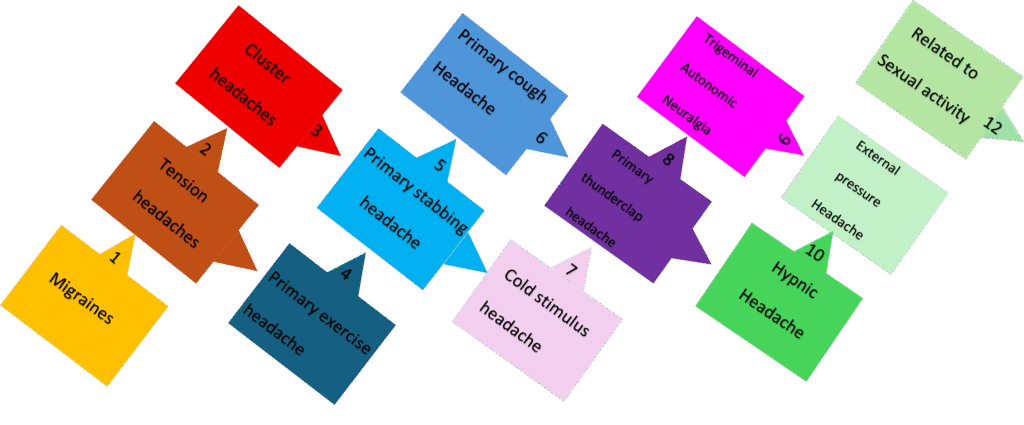
Primary headaches are those headaches with no underlying disease. Migraines, tension headaches, headaches associated with physical exertion, cough headaches and cluster headaches are common examples of primary headaches. The image below lists these and the other types of primary headaches.
Secondary headaches are those where there is an underlying factor- e.g. headaches due to medication, infection, trauma or a mass in the brain etc.

TYPES OF SECONDARY HEADACHES- IHS classification ICHD-3
The study that was mentioned above by Silva-Neto et. al., found that odours triggered migraines only in migraine sufferers, those people with other types of primary headaches were not similarly affected. Approximately 1/3 of the headaches in migraine patients were associated with strong odours.
Another study by Imai et al 2023, classified which odours, if any at all, were most likely to induce headaches in migraine sufferers. First off, the study concluded that the majority of the participants (78%) did experience migraines due to odours, with perfume being the most common trigger (55.4%). This was followed by tobacco, fabric softener, body odour, garbage and special mention to hair dressing products because they are one of my triggers (22.8%). A number of other odours were tested as well (e.g. sweat, machine oil, garlic, alcohol are among the few). Patients can be triggered by multiple odours.
The diagram below shows presents this is picture format.
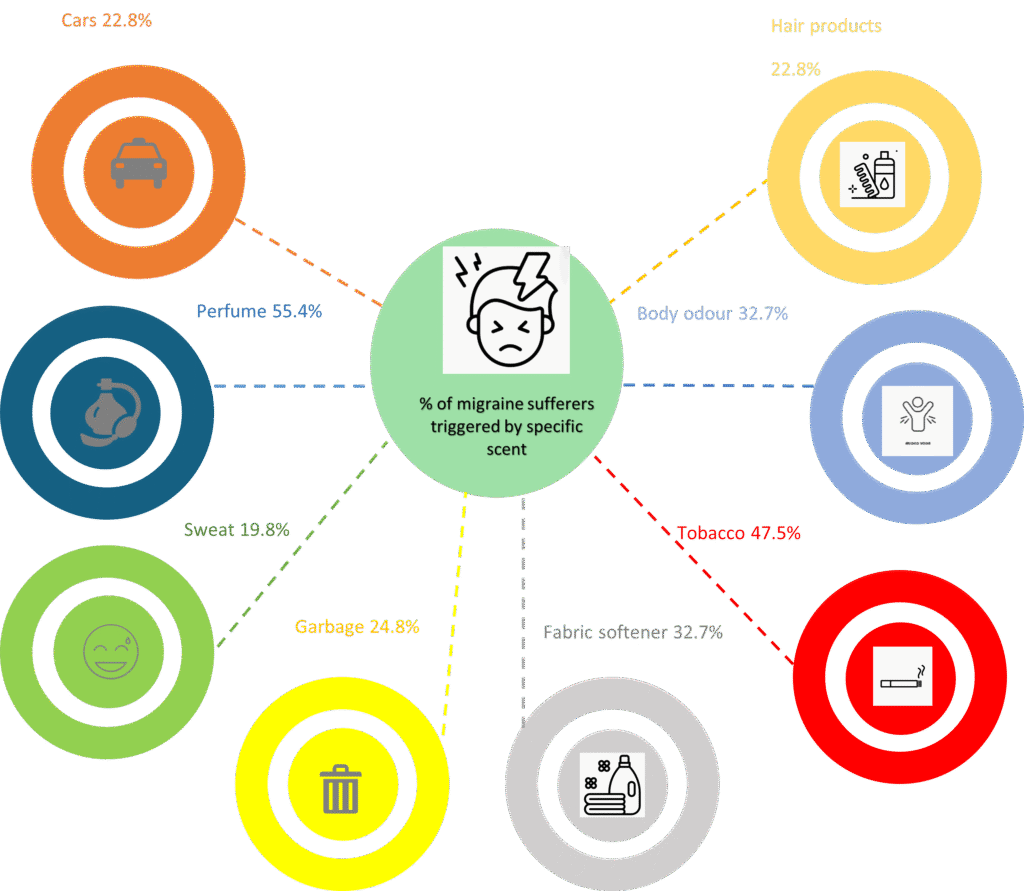
INFORMATION TAKEN FROM IMAI ET AL 2023- CLASSIFICATION OF ODOURS MOST LIKELY TO TRIGGER MIGRAINE ATTACKS
The olfactory threshold (the particular concentration at which a person can detect an odour) and olfactory discrimination (the ability to distinguish between different odours) is lower in migraine sufferers. (Kayabaşoglu et al 2017). This means that people who are prone to migraines can detect odours at lower thresholds, they pick up the odours quicker.
Odours can stimulate 2 of the cranial nerves and this is possibly how they may thereby induce headaches, through the olfactory nerve in the brain and part of the trigeminal nerve. (Imai N et al 2023)
Treatment of these types of headaches can include the following: (Smith, Lisa 2025)- webpage-Association of Migraine Disorders, Feb 6th 2025):
(1) Identify and Avoid triggers wherever possible, the use of a migraine diary may help to identify specific triggers.
(2) Consider using unscented health, beauty and cleaning products at home.
(3) Propose a work or school environment that is scent free if possible.
(4) In severe cases, the use of respirator may be necessary to avoid inhalation of fumes.
(5) Start a comprehensive migraine treatment plan which may include both preventative and treatment medications.
Bibliography
Silva-Néto RP, Rodrigues ÂB, Cavalcante DC, et al. May headache triggered by odors be regarded as a differentiating factor between migraine and other primary headaches? Cephalalgia. 2017;37(1):20-28. doi:10.1177/0333102416636098.
Imai N, Osanai A, Moriya A, Katsuki M, Kitamura E. Classification of odors associated with migraine attacks: a cross-sectional study. Sci Rep. 2023 May 25;13(1):8469. doi: 10.1038/s41598-023-35211-7. PMID: 37230996; PMCID: PMC10213061
Kayabaşoglu, G., Altundag, A., Kotan, D., Dizdar, D. and Kaymaz, R., 2017. Osmophobia and olfactory functions in patients with migraine. European Archives of Oto-Rhino-Laryngology, 274, pp.817-821.
Lisa Smith.,2025 Feb 6th. webpage-Association of Migraine Disorders